
Does a Small Company Need a Spare Vehicle? How to Assess Downtime Risk
The decision to keep a spare vehicle should follow a simple comparison between the ongoing costs of maintaining a spare vehicle and the expected losses from downtime. Below you will find tools and guidance to help calculate the risk and choose the most cost-effective strategy for a small fleet.

Why consider a spare vehicle?
Unplanned vehicle downtime is not only the cost of repair - it also means lost revenue, driver wages, potential contract penalties and administrative costs related to arranging a replacement. In industry literature the actual “full” cost of downtime for some operations can be in the order of hundreds of dollars per day (commonly cited range ≈ USD 448-760/day) (Fleet Maintenance, Element Fleet).
For heavy vehicles there are also example hourly benchmarks (ATRI indicates values comparable to ≈ US$90-91 per hour in operational cost analyses). This shows that for businesses dependent on continuous vehicle availability, downtime accumulates quickly.
For small fleets the decision on holding a spare should consider: how often downtime occurs, how long it lasts, the value of lost work and how quickly alternatives are available (rental, dealer replacement vehicle, outsourced repairs).
- Downtime = multidimensional loss: revenue + labor costs + logistics + penalties.
- Downtime costs vary significantly by industry and vehicle type.
- The decision to hold a spare should be based on data (not intuition).
What to calculate - components of downtime cost
To assess risk, gather data on: the number of downtime events per year, the average downtime per event, the company’s operational costs per hour/day attributable to the vehicle and any SLA penalties or lost revenue per hour of work.
Add indirect costs to direct costs: reorganizing work after a vehicle change, customer delays, extra administration, and logistics costs related to transporting cargo or rerouting jobs.
- Direct: repair, towing, rental of a replacement vehicle.
- Indirect: lost revenue, SLA penalties, additional driver/coordinator labor time.
- Benchmarks from the literature can be used as reference points, but it is best to replace them with your own data.
Simple model: expected loss (E[cost])
The simplest way to compare options is the expected loss model: E[cost] = number of downtime events per year × average downtime per event (in hours) × cost per hour of downtime.
If you know the number of events and the average time, plugging in realistic hourly costs will give you an annual value that can be compared with the annual costs of owning a spare vehicle (depreciation/lease, insurance, service, parking, registration).
- Sample sources: daily downtime cost range ≈ USD 448-760 (Fleet Maintenance), heavy-truck cost ≈ US$90-91/hr (ATRI) - use as reference points, not as universal values.
- If E[cost] > annual costs of maintaining a spare vehicle → purchase may be justified.
- If E[cost] < costs of maintaining a spare vehicle → consider alternatives.
How many spares to hold - practical rules
There is no single universal “spare ratio” - in public transport and passenger services it is often assumed to be 10-20%, while in commercial practice for small fleets common recommendations fall in the 6-15% range depending on the effectiveness of PM and telematics (TCRP / industry practice).
For a small fleet (a dozen or so vehicles) keeping a large share of spares raises the unit cost of holding a reserve. With low failure rates and good service organization it makes sense to consider a lower rate or a combined model of own spares plus external services.
- Indicatively: 10-15% as a starting point for service companies.
- 6-10% possible with tight PM, telematics and easy rental access.
- For critical operations (e.g. time-sensitive deliveries) prefer a higher share of spares.
Alternatives to owning your own spare
Owning a spare is only one option. Alternatives include short-term rental, a replacement vehicle from a dealer/lessor, outsourced mobile repair with SLA, or pooling spares between locations. Each option has a different cost and response-time profile.
In practice rental can be economical for rare and short downtimes, while for frequent or long-lasting failures rental costs may exceed owning a spare vehicle.
- Rental: flexibility, no fixed costs, but higher hourly/daily cost with prolonged use.
- Vehicles from a dealer/lessor: often quick access, but limited vehicle choice and contractual conditions.
- Outsourced repairs/mobile service: reduces the need for a spare if repair time is short.
- Pooling between locations: a good solution for companies with multiple bases.
Practical evaluation plan for a small company - step by step
-
Collect data for the last 12 months: number of breakdowns/failures causing unavailability, average downtime, direct costs (towing, repairs, rental) and any penalties/lost revenue.
-
Calculate E[cost] according to the model above and compare it with the annual costs of maintaining one spare vehicle (depreciation/lease + insurance + service + parking).
-
Perform a sensitivity analysis: change parameters (more/ fewer events, longer/shorter repair time) and check when the purchase of a spare becomes cost-effective.
-
Assess availability of alternatives (rental prices, mobile service SLAs, replacement conditions from lessors). Pilot one alternative in practice before buying a spare.
-
Set a response policy: who decides to use the spare vehicle, handover procedures and records of use (to monitor actual spare utilization).
- Collect data regularly - the decision should be reviewed annually.
- Set decision thresholds: e.g. if E[cost] > X zł per year → purchase a spare.
- A rental pilot lets you verify real reaction-time costs.
Common pitfalls and final remarks
Do not rely on generic numbers without tailoring them to your business - downtime costs strongly depend on company profile (courier, service, mobile sales) and on local market conditions and currency. Use benchmarks (Fleet Maintenance, ATRI, TCRP) as reference points, not as decisive oracles.
Remember hidden costs: spare administration, rotation of the reserve, additional inspections. If you decide to keep a spare, implement record-keeping procedures and periodic readiness tests to maintain actual availability.
In the end - take a pragmatic approach: calculate, test alternatives and choose the solution that minimizes total costs at an acceptable level of operational risk.
- Check data annually and after major operational changes.
- Include currency and local labor cost in your calculations.
- Negotiate terms with rental and service providers before you give up a spare.
Summary
There is no universal answer for a small fleet - buying a spare vehicle makes sense if the expected cost of downtime exceeds the costs of maintaining the spare car. Use the simple E[cost] model, collect your own data, run rental or SLA tests and decide based on a comparison of costs and an acceptable level of risk. If you need support with data analysis or arranging a replacement vehicle, consider fleet management, repair coordination or company replacement-vehicle services.
More from the FleetPoint knowledge base
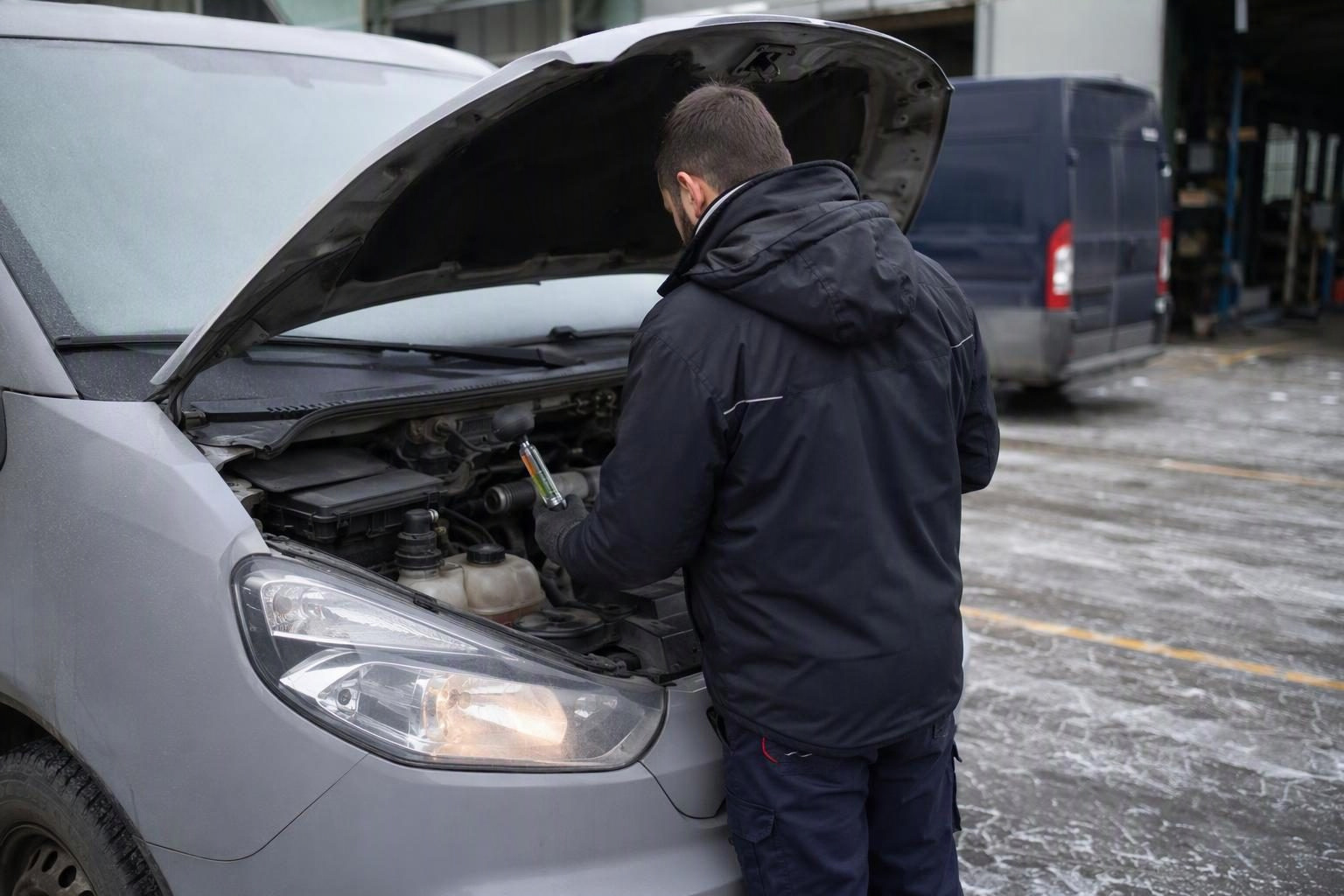
Coolant in vans before winter: planning a check of frost protection
Find out which vans need a pre-frost coolant check, how to interpret the test result and plan visits without unnecessary downtime.
Read article
Lighting checks for a delivery fleet: how to plan inspections and repairs without unnecessary downtime
How to check company van lights, record faults and schedule measurements and repairs without taking several vehicles off the road at once.
Read article
Diesel van will not start after an overnight frost: when to book fuel system diagnostics
Find out what symptoms to report, when to hold a van back from a trip and what the workshop should check in the fuel system.
Read article