
Why assign service costs to a specific vehicle?
Assigning service costs to a specific vehicle turns intuition into data-driven decisions. This lets the fleet owner see the real TCO, identify expensive outliers and have stronger arguments when negotiating with garages or the lessor.

What assigning costs to a vehicle delivers - the role of TCO
Assigning service expenses to a specific vehicle makes it possible to calculate the real Total Cost of Ownership (TCO) at the vehicle level. Instead of assessing the fleet “globally,” you see how much a particular vehicle actually costs over its lifecycle.
As a result, decisions - replacement versus further repairs, choice of model at replacement - stop being intuitive and become comparable. This is fundamental information when planning budgets and replacement strategy.
- TCO includes purchase/leasing costs, fuel, service, parts and indirect costs (downtime, substitute logistics).
- Comparing TCO between vehicles lets you determine which cars generate excessive expenses.
Identifying “outliers” and prioritizing actions
Tracking costs per vehicle reveals vehicles that are disproportionately expensive to maintain. Such “outliers” often point to issues to be fixed or vehicles that should be replaced.
After detecting a deviation, it is worth verifying the cause - whether it is a one-off failure, a recurring design problem, the driver’s driving style, or insufficient preventive maintenance.
- Short-term actions: organize service history, check repair quality, assess parts costs.
- Medium- and long-term actions: vehicle replacement plan, driver training, preventive programs.
Using data in negotiations and warranties
Vehicle-level cost data strengthens your negotiating position with garages, parts suppliers and lessors. The ability to show actual costs and service volumes makes it easier to negotiate better rates or service terms.
In cases of complaints, warranty claims and service campaigns, it is also easier to document costs if every order is assigned a VIN or other vehicle identifier.
- Compare the costs of the same procedures between suppliers.
- Use the repair history to support warranty claims or part returns.
KPIs worth measuring at the vehicle level
Monitoring specific vehicle-level indicators makes comparisons and decisions easier. Even simple KPIs show which cars need attention.
Set a simple set of indicators and report them regularly - monthly or quarterly.
- Cost per km (PLN/km) - includes fuel, service and parts.
- Monthly cost or lifetime-to-date cost for each vehicle.
- Number and cost of breakdowns per 10,000 km; downtime (days) per vehicle.
- Cost comparisons between models, years and user groups.
Automating data collection and system integration
Reliable analyses require a complete and organized database: invoices with VIN/rego, mileage, repair description and cost. Fleet management systems and service modules can automate this.
Automation reduces administrative costs, shortens event registration time and allows faster reactions - e.g. scheduling inspections or spotting cost increases.
- Integrating invoices with the fleet system (OCR, API) reduces manual bookkeeping.
- Telematics and service modules provide context: mileage, driving style, location of failures.
- Regular data audits ensure KPI reliability.
Accounting for indirect costs and a holistic approach
Analyzing service costs based only on invoices can be misleading. You should include indirect costs: downtime, substitute vehicle logistics, loss of employee productivity or impacts on on-time delivery.
Including these costs often changes priorities - a financially costly but short repair may be economical compared with a long downtime.
- Include average downtime and the cost of a substitute vehicle in the analysis.
- Compare scenarios: immediate repair vs. vehicle replacement.
Risks, limitations and tax issues
Data only makes sense if it is complete and correctly identified. Gaps in invoices, missing VINs or inconsistent mileage will distort results and can lead to wrong decisions.
Matters related to VAT, deductions or depreciation depend on regulations and vehicle usage details. Before making accounting changes consult a tax advisor or the tax office.
- Beware of one-off events - verify whether high costs are a trend or an incident.
- Maintain a vehicle identification policy (VIN/rego) and document completeness.
- Confirm VAT deduction rules with an advisor - regulations can change.
Summary
Assigning service costs to a specific vehicle is a practical fleet management tool: it improves TCO visibility, reveals expensive units, strengthens your negotiating position and enables calculation of useful KPIs. For the analysis to be meaningful, base it on complete data, include indirect costs and consult a tax advisor about tax implications. If you want to start, consider automating invoice collection and integrating with a cost-reporting module.
More from the FleetPoint knowledge base
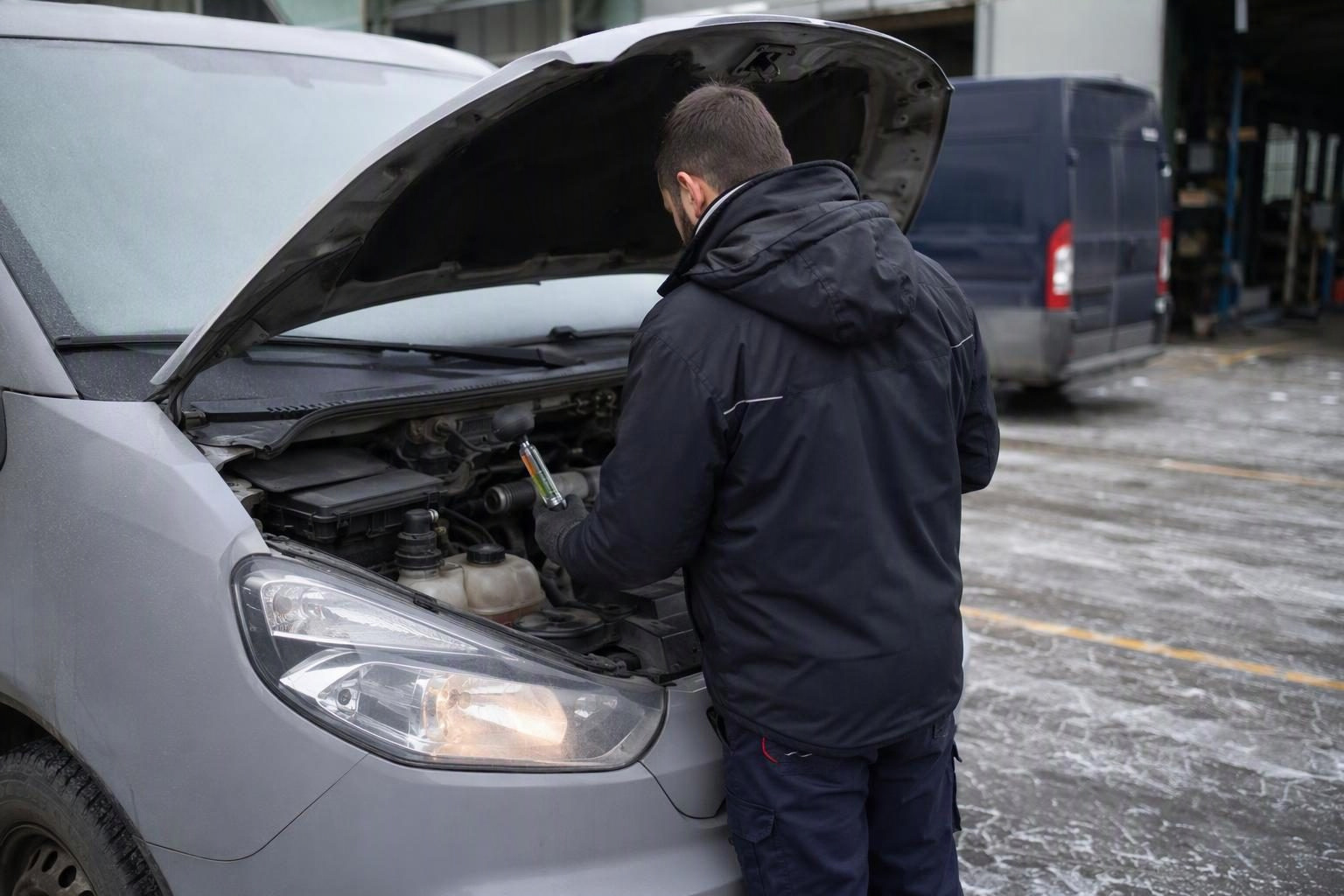
Coolant in vans before winter: planning a check of frost protection
Find out which vans need a pre-frost coolant check, how to interpret the test result and plan visits without unnecessary downtime.
Read article
Lighting checks for a delivery fleet: how to plan inspections and repairs without unnecessary downtime
How to check company van lights, record faults and schedule measurements and repairs without taking several vehicles off the road at once.
Read article
Diesel van will not start after an overnight frost: when to book fuel system diagnostics
Find out what symptoms to report, when to hold a van back from a trip and what the workshop should check in the fuel system.
Read article