
How to Reduce Unplanned Downtime of Company Cars?
Unplanned downtime costs time and money. This article shows which tools and simple procedures are worth implementing first to practically reduce the risk of failures and shorten response times.

Why Act Against Unplanned Downtime?
Unplanned downtime lowers vehicle availability and raises costs - not only repair costs, but also those for replacement cars, cancelled jobs or penalties for delays.
For small and medium fleets the greatest value comes from quick, well‑thought process changes: better problem detection, simpler service decisions and ready parts for the most common repairs.
Telematics providers and implementation cases show that in practice it is possible to reduce the number of unplanned downtimes (reports indicate changes on the order of around a dozen percent), but results depend on the fleet’s starting condition and the quality of the implementation.
Telematics and Remote Diagnostics - What Do They Actually Deliver?
Telematics is simple: devices that collect data from the engine and other sensors - diagnostic trouble codes (DTC), battery health, tyre pressure (TPMS) or engine hours. This lets you detect problems earlier, before they immobilise the vehicle.
Telematics providers report that remote diagnostics reduce the number of unexpected breakdowns, because many issues can be scheduled for the workshop instead of reacted to “on the spot.” It’s a common first step in fleet optimisation.
Legal and privacy note: telematics records location and may include recordings - before deployment check information obligations and the legal basis (in the EU: RODO (GDPR)) and local labour regulations.
Predictive Maintenance - When Does It Make Sense and How to Start?
Predictive maintenance (failure prediction) is an analysis of telematics data and repair history to forecast what will fail and when. It can improve vehicle availability, but requires quality data and a phased approach.
A proven implementation model is phased: (1) strategy and cost‑benefit assessment, (2) pilot on a narrow group of vehicles, (3) measurement of effects and scaling. Industry analyses recommend such an approach.
If repair history is fragmentary, first organise the records (a program or notebook where you log repairs and inspections). Without good data, predictive tools will provide little useful guidance.
Simple KPIs That Actually Help Reduce Downtime
Choose a few simple indicators that connect to operational decisions - numerous, elaborate reports alone will not improve availability.
Key indicators in plain language: percentage of vehicles available (uptime), percentage of preventive maintenance completed (PM compliance), number of road calls per vehicle per month, mean time to repair (from report to completion) and repair cost per kilometre.
- Uptime - what percentage of the fleet is ready to work each day.
- PM compliance - whether scheduled inspections based on km/hours are performed on time.
- Road calls / vehicle / month - how often a vehicle requires emergency assistance.
- Mean time to repair - how quickly we respond and close orders.
- Repair cost per km - controlling the cost-effectiveness of repairs and operation.
Parts Management: What Works for SMEs
Key principles: classify parts by criticality, reduce the number of distinct stock items (SKUs) and prepare kits for the most common repairs. This helps avoid delays due to a missing part.
Practical models: min/max for the most important components, or cooperation with a supplier for rapid replenishment (vendor‑managed inventory) for fast‑consuming items.
Financial note: holding too many parts ties up capital. Do a short analysis: which parts actually cause downtime and which are rarely used.
The Driver’s Role and Simple Inspection Procedures
Drivers are the first line of problem detection. A simple daily check before and after driving (a digital inspection form instead of paper) shortens response time and prevents small faults from escalating into breakdowns.
Implement clear rules: what to report immediately, how to report (app, SMS, phone) and who decides to immediately send the vehicle to the workshop.
In jurisdictions with formal inspection rules (e.g. DVIR in the USA), use ready‑made form templates - this eases compliance and auditing.
Implementation Steps for a Small Fleet - A 3-12 Month Plan
-
Baseline audit: collected service data, list of critical parts, number of road calls, current driver procedures.
-
Quick wins: basic telematics to read engine codes and hours, digital inspection forms, PM schedules based on actual km/hours and kitting for the most common repairs.
-
Pilot: select 10-20% of the fleet (or the few most problematic vehicles) and test telematics + the repair reporting process for 3-6 months.
-
Integration: push telematics alerts directly into the program or system where you log repair orders (or to a trusted repair coordinator). Automatic service order on a critical code shortens response time.
-
Measure and scale: compare KPIs before and after the pilot. If results are positive, expand gradually to the whole fleet and refine parts management.
Remember training: a tool without process and accountability will not deliver results.
Summary
Reducing unplanned downtime is a combination of technology and simple processes: telematics and digital inspections deliver quick benefits, prediction requires phased implementation and solid data, and parts management plus clear KPIs ensure alerts turn into fast decisions. If you need help with an audit, pilot or repair coordination - you can start by checking services: fleet management, repair coordination or company car servicing.
More from the FleetPoint knowledge base
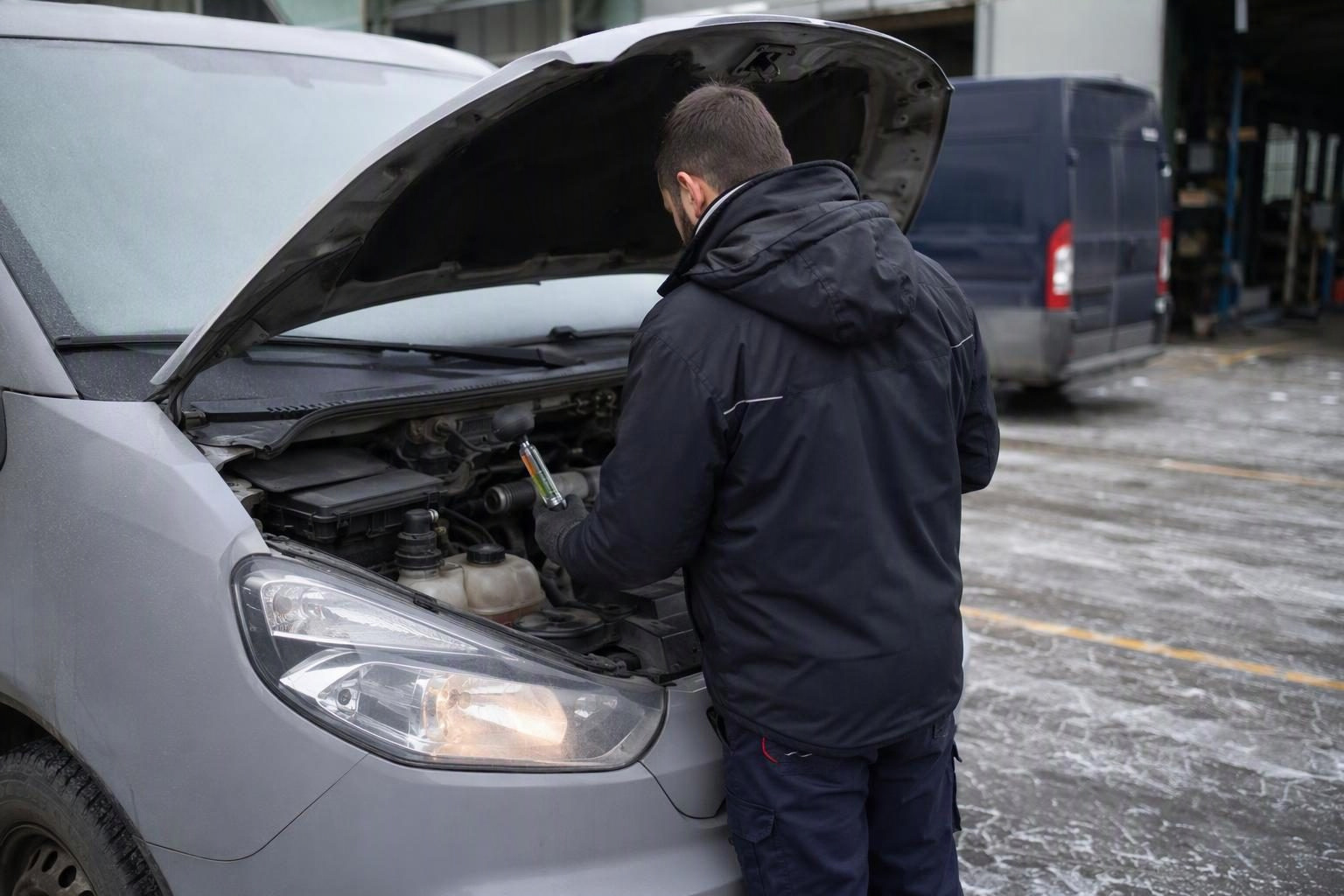
Coolant in vans before winter: planning a check of frost protection
Find out which vans need a pre-frost coolant check, how to interpret the test result and plan visits without unnecessary downtime.
Read article
Lighting checks for a delivery fleet: how to plan inspections and repairs without unnecessary downtime
How to check company van lights, record faults and schedule measurements and repairs without taking several vehicles off the road at once.
Read article
Diesel van will not start after an overnight frost: when to book fuel system diagnostics
Find out what symptoms to report, when to hold a van back from a trip and what the workshop should check in the fuel system.
Read article