
How to establish rules for approving repair costs in a company?
A short, unambiguous policy for approving repair costs reduces downtime, lowers the risk of excessive spending and simplifies accounting. This guide shows which rules to introduce, which documentation fields to require, how to organize a simple workflow and which integrations and metrics to prioritise.

Purpose and scope of the policy
The policy for approving repair costs has two objectives: enable a quick response to breakdowns (minimise downtime) and protect the budget (avoid unjustified expenses). In a small fleet the single responsible person may be the owner, but day‑to‑day decisions should lie with the fleet administrator or a designated coordinator.
Clearly define what the policy covers: mechanical repairs, consumable parts, bodywork and paint repairs, post‑warranty repairs, etc. Also state whether the policy covers leased vehicles, private cars used for business purposes and outsourced service providers.
- Separate operational authorisations (driver/coordinator → ordering, emergency repairs) from financial decisions (cost/purchase approval).
- Define the cost‑center owner for each vehicle (which accounting ledger/account pays).
- Specify people and backups: who approves outside working hours and who retroactively confirms emergency decisions.
Proposed approval matrix
A practical matrix has three decision levels: critical/safety repairs, minor/routine work and work exceeding a financial threshold. Thresholds are better set relatively - as a percentage of vehicle value or as fixed amounts by vehicle class (e.g. passenger car, van, heavier delivery vehicle) - rather than a single amount for the whole fleet.
The “repair‑vs‑replace” heuristic: if a single repair estimate approaches a significant percentage of the vehicle’s market value (often cited in the literature at about 40-50%), this triggers a mandatory analysis of replacement instead of automatic approval of the repair. This is a starting point - adjust to your TCO and the used‑vehicle market.
- Level 1 - critical/safety repairs: the driver or the nearest workshop carries out repairs necessary for safe continued driving; retroactive approval is required on the next business day.
- Level 2 - minor/routine (e.g. filter changes, minor faults): approved by the fleet coordinator based on an estimate.
- Level 3 - work above the financial threshold for the vehicle class: requires approval from the owner/accounting and comparison of quotes.
Emergency mode and reporting by the driver
The driver must have the right to order work necessary to safely continue the trip outside business hours, but every such order must be documented and reviewed. This approach minimises downtime while allowing cost control after the fact.
Introduce clear reporting rules: what the report must include, who it is addressed to and the deadline for retroactive approval. Also set channels: an app, a DVIR form (if you use one) or phone plus an email confirmation.
- In emergency mode the driver provides: fault description, photos, odometer reading, location, workshop name, estimated cost if available.
- After returning to the office: the coordinator verifies the documents, checks the invoice and confirms the authorisation or raises issues.
- Record telephone authorisations: date, person, phone number and a short note - useful for accounting and insurance.
Minimum documentation fields (work/repair order)
Good documentation is the basis for cost control, settlements with workshops, warranty claims and possible complaints. In a small fleet a relatively simple form is sufficient, which should always be completed by the workshop and the coordinator.
- Unique job identifier and the date and time of receipt/completion.
- Payer/cost‑center owner (which accounting account pays).
- Vehicle details: VIN, registration number, make/model, fleet number.
- Odometer/readout of engine hours on receipt and on release.
- Fault description (driver’s words) + mechanic’s diagnosis (cause and actions taken).
- List of used parts with catalogue numbers and quantities and labour hours (estimated and recorded).
- Estimate before work and final invoice; warranty status of parts/labour.
- Signature/ID of the approving person, photos before/after, purchase order (PO) number or a field for telephone authorisation.
Simple workflow step by step
Design a workflow that reduces burden on the owner and requires their consent only where truly necessary. Automation can be modest - even an e‑mail with a structured form significantly shortens response time.
The scheme below fits most small fleets and can be implemented without specialised software.
-
- Report by driver (app/DVIR/phone with confirmation) →
-
- Initial assessment by coordinator: is the asset safe to drive? →
- 3a) If unsafe: authorise emergency repair and order the workshop; 3b) If safe: request an estimate from the workshop →
-
- Compare the estimate to thresholds and, if necessary, escalate to the owner/accounting →
-
- Perform the work, document with photos/invoice →
-
- Close the job, record the expense in accounting and append to the vehicle history.
Integrations and tools worth considering
You don’t have to buy an expensive system right away. Consider integrations that will deliver the greatest effect: telematics for automatic alerts, a simple cloud‑based job system and integration with accounting. If you talk about a ‘CMMS’, use the simpler description - it’s just software or a notebook where you record repairs and inspections.
Even basic connections reduce manual work and shorten approval time.
- Telematics / DVIR: automatic fault alerts, odometer readings and photos from the breakdown site.
- Cloud‑based job system: create jobs, attach invoices and photos, automatic escalations.
- Accounting / AP: passing invoices and PO numbers to prevent payments without documentation.
- Parts catalogue / inventory and fleet card: faster reconciliation and price verification.
Metrics and audit - what to monitor from the start
A small fleet does not need dozens of metrics. Focus on a few that will show where the budget leaks and which vehicles are problematic.
Regular audits of workshop documents and comparing invoices to estimates reduce the risk of fraud and facilitate warranty claims.
- Maintenance cost per mile - the basic measure of a vehicle’s cost efficiency.
- Planned maintenance compliance rate - are inspections performed on time.
- Planned vs reactive % - the higher the share of planned work, the fewer costly breakdowns.
- Vehicle availability (uptime) and time from report to decision (time‑to‑approval).
- Repeat repair rate and the share of parts costs in total repair costs.
How to start and how to maintain the policy
Begin implementation with simple rules and a single approval table. Appoint responsible people, prepare a simple repair form and rehearse the emergency procedure with drivers.
Review thresholds and rules quarterly during the first 12 months - the used‑vehicle market and parts costs change, so don’t copy thresholds mechanically.
- Appoint an owner of the policy (the person who updates it) and schedule a short training for drivers and workshops.
- Start by monitoring a few KPIs and a monthly report; expand the dashboard only if it adds value.
- Require detailed invoices from workshops (parts with numbers, labour hours, rates) and keep photos and records of authorisations.
Summary
A simple, well documented policy for approving repair costs enables fast action in emergencies while supervising expenditures. Start with a clear approval matrix, enforce minimum documentation fields and connect the key tools (telemetry → jobs → accounting). Regular threshold reviews and basic cost reports will show which vehicles truly burden the budget.
More from the FleetPoint knowledge base
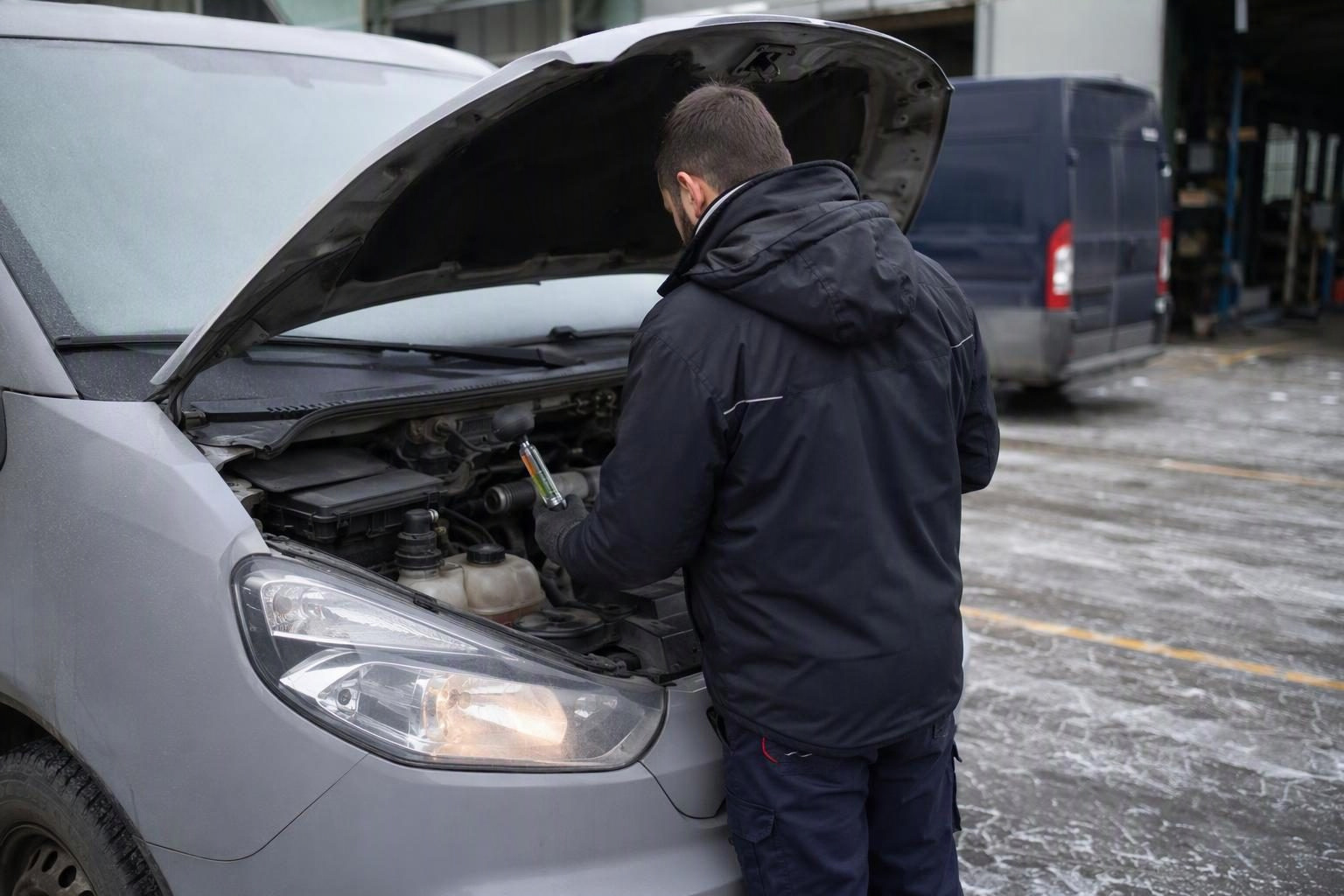
Coolant in vans before winter: planning a check of frost protection
Find out which vans need a pre-frost coolant check, how to interpret the test result and plan visits without unnecessary downtime.
Read article
Lighting checks for a delivery fleet: how to plan inspections and repairs without unnecessary downtime
How to check company van lights, record faults and schedule measurements and repairs without taking several vehicles off the road at once.
Read article
Diesel van will not start after an overnight frost: when to book fuel system diagnostics
Find out what symptoms to report, when to hold a van back from a trip and what the workshop should check in the fuel system.
Read article