
Van batteries before the first frost: how to prioritise checks without taking the whole fleet off the road
First, send vehicles with slower starting, dimming lights, and those mainly used for short journeys with frequent stops for checks. Schedule the remaining vehicles in stages, so you have enough vehicles available for work each day.
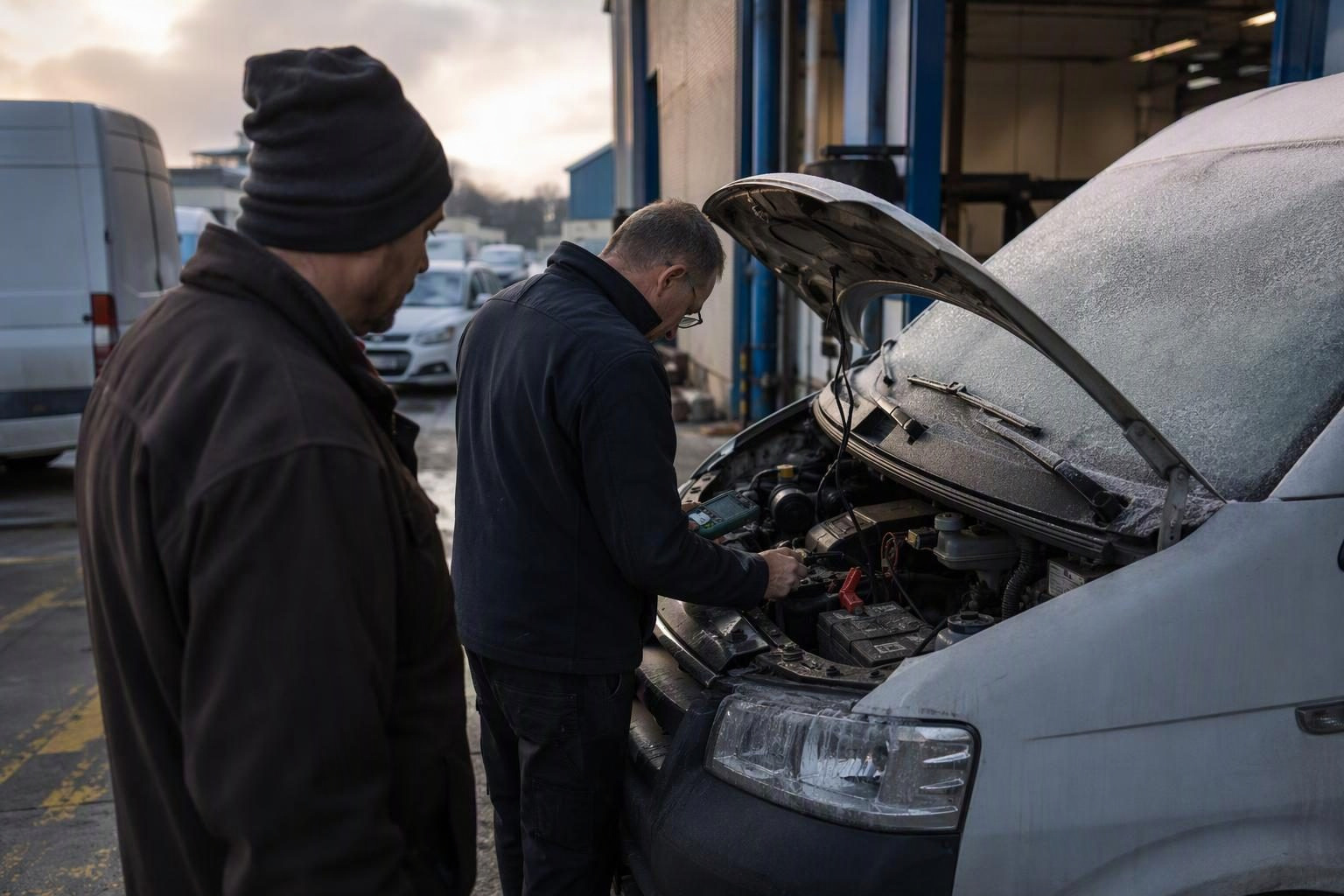
Start with vehicles showing symptoms or operating in demanding conditions
You do not need to take the whole fleet off the road and send it to the workshop at once before the first frost. Start by making a simple distinction: which vehicles are already showing signs of starting problems, and which are used in conditions that increase the risk of the battery not being charged sufficiently. This helps you set a checking order before starting the vehicle in the morning becomes a problem.
Put vehicles in the first group if their drivers report that the starter motor turns more slowly or with more difficulty than usual. Also look out for reports that the lights dim quickly after the engine is switched off. These are warning signs, but they do not in themselves confirm that the battery is faulty. The workshop should make the final assessment.
Give higher priority to vehicles mainly used for short journeys, started frequently and left parked for long periods. In these conditions, the alternator may not replace the energy used for starting and powering electrical equipment. Low temperatures also reduce battery performance and increase the energy needed to start the engine.
- First in the queue: reported slower or more difficult starting.
- High priority: lights that dim quickly after the engine is switched off.
- High priority: frequent short journeys, starts and long periods parked.
- Lower priority does not mean no check is needed. It only means a later appointment if the vehicle has no reported symptoms and does not have an identified risk profile.
Collect reports before booking appointments
Before speaking to the workshop, ask drivers for a brief description of any symptoms and how they use the vehicle. You do not need a detailed form. The important thing is to distinguish a vehicle with a specific warning sign from one that simply makes a lot of short trips.
Record each report against the specific vehicle, not only in a message associated with the driver. If the vehicle changes hands, its symptom history should still be available to the person planning the service. Include the date and a brief description: when the driver noticed that starting was more difficult and the conditions in which the vehicle is usually used.
Do not base the order solely on battery age. There is no universal age or mileage at which a van battery should be replaced. Age alone is no substitute for diagnostic results or the information supplied by the manufacturer of the specific vehicle.
- Vehicle registration or identification.
- Symptom reported by the driver and date of the report.
- Whether the vehicle is used mainly for short journeys, is started frequently or is parked for long periods.
- When the vehicle is available for a check and whether it is needed for work on a specific day.
Schedule visits so the fleet can keep working
Set the order according to risk and vehicle availability, rather than booking one appointment for the entire fleet. Plan vehicles with symptoms first. Then add vehicles used intensively for short journeys and with frequent stops. Vehicles with no reports and no such usage profile can be booked for later appointments.
Before confirming appointments, check how many vehicles the company can actually make available on a given day. Keep enough vehicles in service to carry out the work, and spread the remaining appointments over subsequent days or batches. Agree availability and a service plan for the specific fleet with the workshop. Sources do not give a universal checking time or a number of vehicles that can be checked during one shift, so do not assume in advance that the workshop will handle a particular number of vehicles.
Staggering appointments is a practical way to organise the work, not a prescribed standard. If a driver reports a new symptom while waiting for an appointment, update the queue and discuss the change in priority with the workshop.
- Step 1: book appointments for vehicles showing symptoms.
- Step 2: plan checks for vehicles with an urban, short-distance usage profile.
- Step 3: schedule the remaining vehicles in line with fleet and workshop availability.
- Step 4: update the list of vehicles and any follow-up actions after each check.
What to ask the workshop to check
Checking the resting voltage alone can be a useful initial filter, but it does not determine the condition of the battery. Sources cite different charging thresholds, including 12.4 V and 12.5 V. This is a good reason not to treat a single reading as a universal basis for deciding to replace the battery. The measurement conditions and battery type also matter.
Ask for a battery test result and a check of the charging system. Workshop testers can assess, among other things, the battery’s state of charge and condition, and available equipment can also be used to check the charging system. However, a tester result is not a full assessment of every performance parameter. Some tests focus primarily on starting current, while other characteristics may be determined indirectly.
After the visit, keep the result, check date and the driver’s earlier report with the vehicle’s records. The report will help with the next decision and allow you to compare it with the actual symptoms, rather than replacing the battery solely because of its age.
Pitfalls that can lead to poor prioritisation or unnecessary replacement
The most common organisational mistake is treating every vehicle the same way. A van used mainly for short journeys may need an earlier check than a vehicle with no reported symptoms and a different usage pattern. Grouping vehicles by make, model year or battery age alone is no substitute for information from drivers and test results.
Do not mistake a warning sign for a diagnosis. Slower starting or dimming lights are reasons to send a vehicle for a check, but they do not prove that a new battery is needed. Similarly, a single low voltage reading should not, on its own, determine that the battery needs replacing.
Also avoid planning on the basis of an assumed appointment length or a promise that every vehicle can be checked in one day. There is no confirmed universal checking time or number of vehicles that can be checked in one shift. Agree these details directly with the workshop.
Example: an urban fleet with morning departures
Suppose a company has vans making short journeys around a city. One driver reports that the starter motor is turning more slowly, while several other vehicles regularly start and stop throughout the day. Rather than taking every vehicle off the road at the same time, the fleet administrator puts the vehicle with the reported symptom at the top of the queue and schedules vehicles with frequent starts in the next available batches.
When arranging appointments, the administrator checks which vehicles need to remain in service that day. The workshop confirms availability for subsequent visits, and the results are added to the records for each vehicle after its check. If the test does not indicate that replacement is needed, there is no reason to make that decision solely because of the battery’s age. If the result indicates that further action is required, it can be planned for that vehicle rather than taking the whole fleet off the road straight away.
This is an example of an approach based on symptoms, usage patterns and vehicle availability. It is not a universal schedule or a guarantee that no vehicle will fail to start.
Summary
Create a checking queue based on symptoms and usage, and agree appointments in batches that take the fleet’s daily operations into account. FleetPoint can coordinate visits through a single point of contact, monitor the service process and provide clear accounting for the work carried out. Recorded results make it easier to decide which vehicles need further action, without planning to take the whole fleet off the road at once.
Sources
- Autobatterie laden: So machen Sie die Batterie wieder fit - ADAC
- Autobatterie testen: So prüft man die Spannung der Autobatterie - ADAC
- The right battery for short distances - VARTA Automotive
- Correct battery care - VARTA Automotive
- Testing the battery - Step-by-step - VARTA Automotive
More from the FleetPoint knowledge base

Coolant in vans before winter: planning a check of frost protection
Find out which vans need a pre-frost coolant check, how to interpret the test result and plan visits without unnecessary downtime.
Read article
Lighting checks for a delivery fleet: how to plan inspections and repairs without unnecessary downtime
How to check company van lights, record faults and schedule measurements and repairs without taking several vehicles off the road at once.
Read article
Diesel van will not start after an overnight frost: when to book fuel system diagnostics
Find out what symptoms to report, when to hold a van back from a trip and what the workshop should check in the fuel system.
Read article