
How to plan maintenance for a light commercial vehicle fleet?
A simple maintenance program reduces breakdowns, shortens downtime and organizes spending. The key is combining three pillars: short daily driver checks, scheduled services according to the service book and using telematics for condition‑based maintenance. Below you will find a checklist, KPIs and a ready implementation plan for a fleet of several to a dozen vehicles.

Three pillars of the maintenance program
A well-functioning maintenance program combines three elements: daily checks performed by the driver (walkaround), scheduled services in accordance with the manufacturer’s instructions, and condition‑based maintenance driven by data. This approach is described by industry practices and telematics companies - it combines preventive (planned) maintenance with flexibility based on the actual condition of the vehicle (source: Geotab).
For small fleets this is the optimal balance: a quick daily check catches the most common issues, manufacturer services protect warranties and critical components, and telematics lets you postpone some maintenance tasks until they are actually needed.
- Walkaround - a quick pre‑drive check by the driver (5-10 min).
- Manufacturer scheduled services - intervals recorded in the service book and manuals.
- Condition‑based maintenance - alerts based on mileage, engine hours, fault codes and basic measurements.
Daily checklist (example)
The daily check should be short and doable by the driver before departure. It should be recorded (app, photo, signature) - documentation simplifies later accounting and diagnostics.
The list below is a practical minimum you can implement immediately.
- Overall vehicle appearance and cracked windows/mirrors - a quick visual inspection.
- Tires - visible damage, approximate pressure (if a gauge is available).
- Lights and indicators - a brief functional check before departure.
- Oil/coolant - visual level check (not a repair procedure).
- Brakes - pedal feel, unusual noises during a short test drive.
- Documents and load‑securing items - straps, tarpaulins, locks.
- Record in the system/app or take a photo and add a short note about any irregularities.
Telematics: what it delivers and how to start
Telematics are devices and software that collect data from the vehicle and driving. For a small fleet it delivers three practical benefits: reminders for services based on mileage/engine hours, reading fault codes (DTC) and data for condition‑based maintenance (e.g. engine temperature, fuel consumption, driving style).
You don’t need to invest immediately in advanced sensors. Start with the basics: location, mileage, DTC alerts and engine run time. This lowers the entry barrier and pilot cost, and already improves service scheduling (source: Geotab).
- Set automatic reminders for scheduled maintenance (PM) based on mileage or engine hours.
- Automatic notifications of fault codes (DTC) sent to the administrator or workshop.
- Use collected data to shift some services from the calendar to the actual vehicle condition (e.g. when oil degradation accelerates beyond expectations).
KPIs worth measuring from the start (formulas and directional targets)
Measuring a few simple indicators will help control the program’s effectiveness. Below are formulas and brief explanations. Benchmarks come from industry analyses and should be treated as directional references, not absolute targets.
Collect data monthly and analyze trends - a single result tells little.
- PM compliance = (number of PMs performed ÷ number of PMs scheduled) × 100. Directional target: aim for ≥ 85-95% (industry sources).
- Maintenance cost per km = total maintenance cost ÷ distance in km. Use to compare vehicles and monitor cost trends.
- Vehicle availability / uptime = (available days ÷ total days) × 100. Good fleets achieve 92-98%; a typical industry average may be 88-92%.
- Mean time to repair (MTTR) = total repair time ÷ number of repairs. Shows how quickly you return to operation after a breakdown.
- Unplanned events per 100 vehicles = number of failures/unplanned stops × (100 ÷ number of vehicles).
Step by step: how to implement the program in a small fleet
Implementation does not have to be complicated. The steps below are a practical plan for an owner or administrator of a fleet of several to a dozen vehicles.
It is recommended to run a short pilot (2-4 vehicles) before scaling to the whole fleet.
-
- Fleet and goals audit - assess task types, average mileages, budget and operational priorities.
-
- Tool selection - use the maintenance module in your telematics platform or a simple program/spreadsheet; avoid several unrelated tools at the start.
-
- Prepare checklists and procedures - clear instructions for drivers and the workshop on what to document and how to report defects.
-
- Set KPIs and a dashboard - simple monthly reports (PM compliance, cost/km, uptime).
-
- Pilot with 2-4 vehicles for 4-8 weeks - verify reminders, quality of reports and integration with the workshop.
-
- Train drivers and mechanics - short practical sessions and instructions on how to report the walkaround.
-
- Full rollout and monthly review of results - adjust processes based on pilot data.
-
- Optimization - gradually move some PMs based on actual vehicle data.
Parts, documentation and roles - what to organize from the start
Order in parts and documents shortens repair time and reduces emergency costs. For a small fleet it is worth starting with a list of critical parts and clear team roles.
Roles and communication must be clear: the owner sets goals and budget, the administrator monitors KPIs and orders, drivers perform and document the walkaround, and the mechanic performs and records repairs.
- Critical parts list: filters, brake pads, bulbs, drive belts - keep minimum stock levels in pairs (min/max).
- Document everything: inspection reports, service orders, invoices and photos - history speeds diagnostics and helps with claims handling.
- Establish a simple replenishment process and an escalation path for breakdowns (who contacts the workshop, who decides on a replacement vehicle).
Pitfalls and practical tips
The most common mistakes are failing to record daily checks, low compliance with scheduled maintenance (PM), poorly configured telematics and lack of integration between tools and the workshop. Address these during the pilot before expanding the program.
Also remember regulations: periodic technical inspections for vehicles up to 3.5 t are carried out according to the law (first inspection up to 3 years after registration, then up to 5 years, then annually) - always check the documents and government websites.
- Start with simple solutions and add integrations gradually.
- Treat KPI benchmarks as reference points, not an unquestionable standard.
- Regularly analyze pilot data and refine telematics reminders to avoid false alarms.
Summary
A maintenance program for a delivery fleet does not have to be complicated: focus on the three pillars (daily walkaround, manufacturer services, telematics), document everything and measure a few simple KPIs. Start with a small pilot, organize parts and roles, then scale. If you want, I can help prepare a fleet audit or a sample PM sheet tailored to your vehicles.
More from the FleetPoint knowledge base
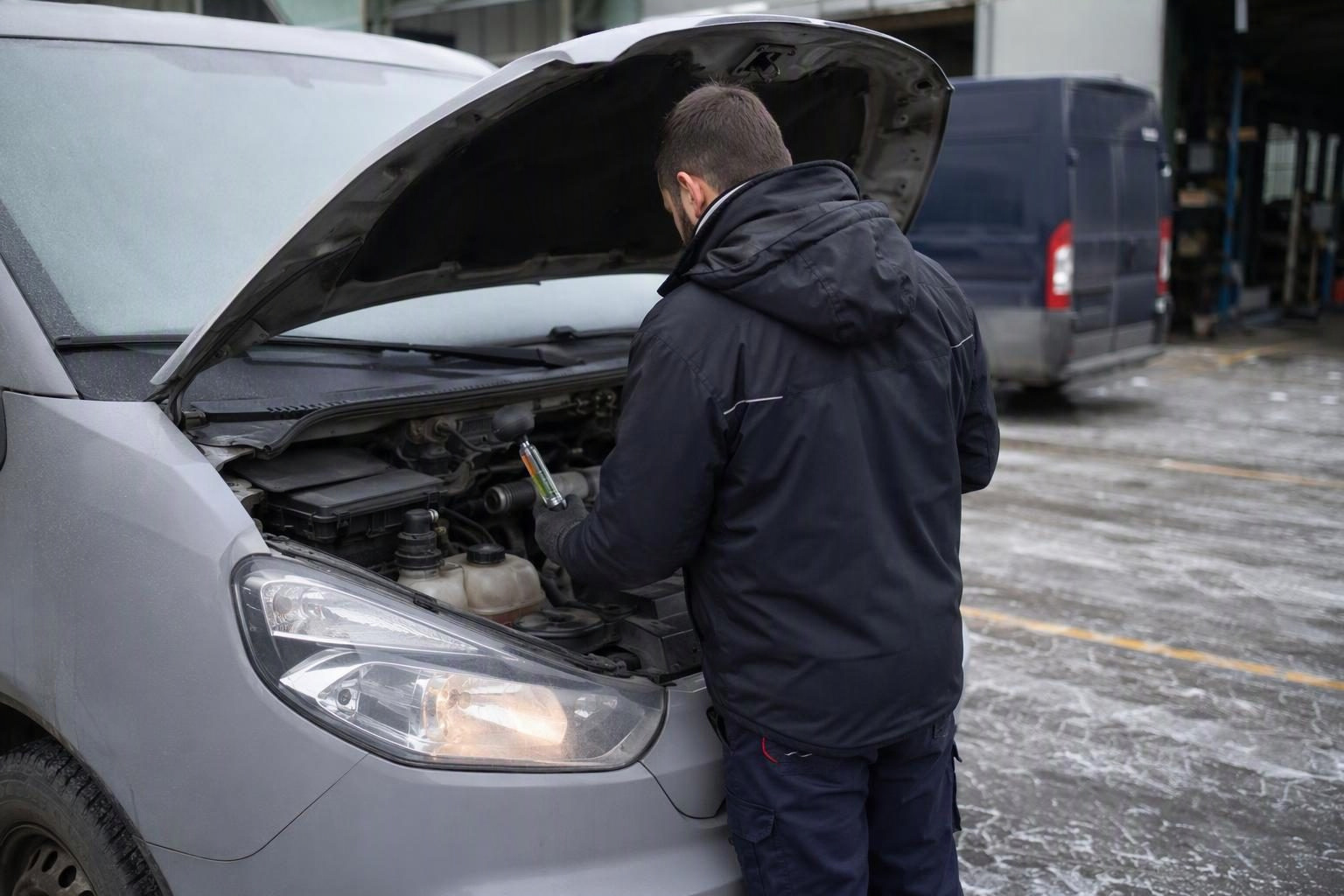
Coolant in vans before winter: planning a check of frost protection
Find out which vans need a pre-frost coolant check, how to interpret the test result and plan visits without unnecessary downtime.
Read article
Lighting checks for a delivery fleet: how to plan inspections and repairs without unnecessary downtime
How to check company van lights, record faults and schedule measurements and repairs without taking several vehicles off the road at once.
Read article
Diesel van will not start after an overnight frost: when to book fuel system diagnostics
Find out what symptoms to report, when to hold a van back from a trip and what the workshop should check in the fuel system.
Read article