
The repair shop is delaying a company car repair: what to clarify to reduce downtime?
When the repair shop postpones the deadline, immediately ask for a written repair status, the reason for the delay, and a specific date and time for the next update or vehicle collection. At the same time, check which jobs the company will lose without the vehicle and whether the cost of a replacement vehicle will be lower than the cost of reorganizing work. Do not base your plan on “it’ll be ready tomorrow,” and do not assume that you are always entitled to a replacement vehicle.

Get a plan first, not another promise
Call the person handling the repair, then ask them to confirm the arrangements by email or text message. Clarify separately what the repair shop knows for certain and what is only an estimate. The new date may depend, for example, on parts delivery, further diagnostics, or approval to expand the scope of work.
Ask specific questions: what is causing the delay, what stage the repair has reached, what work remains, and whether the parts have been ordered. If the repair shop is waiting for a part, ask whether the supplier has confirmed the delivery date or whether it is only an estimate.
Do not accept “it’ll be ready tomorrow” as a plan. Ask for a collection date and time or, if the repair shop cannot confirm these, a specific time for the next update. Also agree on who is responsible for contacting you. That way, you will not have to start from scratch each day to find someone who knows what is happening.
- The reason for the delay and the current stage of diagnostics or repair.
- The status of the parts and their confirmed or estimated delivery date.
- The remaining work and any decisions or approvals required from the company.
- The new collection date and time, or the time for the next update.
- The name and direct contact details of the person handling the repair.
A longer repair may mean additional costs
If the repair shop has found another fault, ask for a description, the proposed scope of work, the cost, and the effect on the timeline. Do not approve additional work based only on a vague statement that “something else needs doing.” Establish who in the company is authorized to approve extra costs and whether approval must be given in writing.
Separate the cost of the repair already agreed from any new items. Ask for an updated estimate or a breakdown of parts and labor costs, then compare it with the repair order and the previous estimate. This helps prevent the delay from becoming a pretext for increasing the bill without your approval.
Also check whether the missing part or additional diagnostics really prevent the entire repair from being completed. This does not mean that the car can be collected and driven. The repair shop should clearly state whether the vehicle is safe and roadworthy, and, if not, what conditions must be met before it can return to service.
- Do not approve additional work without a description, cost, and explanation of its effect on the timeline.
- Record who in the company approved the extra cost and when.
- Ask whether the car will remain at the repair shop and who is authorized to use it.
- Do not collect or use a car with a fault that threatens safety without a clear statement from the repair shop.
Base the replacement vehicle decision on the work that needs to be done
A postponed repair date alone does not mean that a rental is necessary or that someone else will pay for it. First, list the jobs assigned to the vehicle that is out of service. Mark those that cannot be rescheduled, handled using another vehicle, or subcontracted. For a van, consider not only the number of seats but also its fit-out, payload, and the equipment required for the work.
Compare the full cost of replacement mobility with the actual cost of alternatives, such as delayed jobs, subcontracting, overtime, or reorganizing routes. There is no single number of days or cost threshold above which renting is always worthwhile. Recalculate if the repair shop changes its estimate.
Before booking, check the service and leasing agreements, the terms of assistance, the warranty or mobility program, and the comprehensive motor insurance policy. Confirm whether the benefit covers this fault, for how long, what type of vehicle is included, and who is responsible for arranging it. Do not assume that you are automatically entitled to a replacement vehicle for an ordinary breakdown.
If the repair is needed because of damage caused by a third party and covered by their third-party liability insurance, that is a separate process. Whether rental costs can be reimbursed depends on the circumstances and whether the costs are justified. Before renting, document the need for a vehicle, its class, the rate, the rental period, and your contact with the insurer. Do not automatically apply these rules to a mechanical breakdown.
- Does the replacement vehicle need a specific fit-out, payload, or equipment?
- Who will cover the cost, and is prior approval required?
- What is the time limit, vehicle type, and collection procedure?
- Which jobs will be rescheduled, reassigned, or left undone without the vehicle?
Record arrangements and the date the vehicle actually returns to work
Keep a single repair record instead of searching for information across several employees’ phones. Record the agreed scope, cost, repair order number, each reason for a delay, and every subsequently confirmed date. Add the decision about a replacement vehicle and the date the car actually returned to work. Collecting it from the repair shop does not always mean it is ready to carry out jobs, for example, if company equipment still needs to be installed.
Distinguish an estimated date from a date confirmed by the repair shop. Keep text messages and emails, and after a phone call send a brief summary: “I confirm that the delay is due to…, the repair shop is waiting for…, and the next update is due by…”. This is a simple way to reduce misunderstandings.
In your monthly fleet review, you can track repair downtime in days, the share of repairs completed by the last deadline confirmed in writing, the cost of replacement mobility per day of downtime, and the number of jobs reassigned because a vehicle was unavailable. These are business management indicators, not statutory standards or guaranteed market outcomes.
- Registration number, mileage, and the date the vehicle was taken out of service.
- Symptoms reported by the driver and the repair order number.
- Repair shop contact details, agreed scope, cost, and parts status.
- Reasons for delays, confirmed dates, and decisions about a replacement vehicle.
- The date the vehicle actually returned to work.
When to consider changing repair shops or formally escalating the issue
If the repair shop does not provide a reason for the delay, avoids written updates, or repeatedly postpones the deadline without explanation, ask to speak to the service manager. Before making a decision, establish what work has been completed, what has been dismantled, whether the car can be transported safely, and what costs would arise from moving the repair elsewhere. Changing repair shops while work is in progress will not always reduce downtime.
Review the repair order, terms and conditions, and correspondence, including the original agreed deadline and any later confirmations. The Kodeks cywilny (Polish Civil Code) contains provisions on delay by a contractor in performing a contract for specific work, as well as delay in performing an obligation. Which provision applies and what action is appropriate depends on the agreement and the circumstances. Before terminating the agreement or seeking compensation, consult a lawyer about the specific case.
There is no single statutory repair timeframe that applies to every car and every fault. For day-to-day management, the most important things are therefore the terms of the repair order and documented arrangements. Keep your tone calm and factual, but expect clear answers to specific questions and a date for the next contact.
- First, ask for an explanation and a written repair plan.
- Before moving the vehicle, establish the work status, transport safety, and costs.
- If there is a significant dispute, do not base a legal decision solely on general information from the repair shop.
Summary
When a repair is delayed, take two steps in parallel: obtain a written plan from the repair shop with the date of the next update, and calculate how the vehicle’s unavailability will affect the completion of jobs. If several people in the company contact the repair shop, arrangements can easily become contradictory, costs may be approved without authorization, and the decision about replacement mobility may come too late. FleetPoint repair coordination can bring order to the process through a single point of contact, ongoing monitoring of repair status, and transparent billing, helping you respond faster to changes in the timeline and reduce downtime costs.
More from the FleetPoint knowledge base
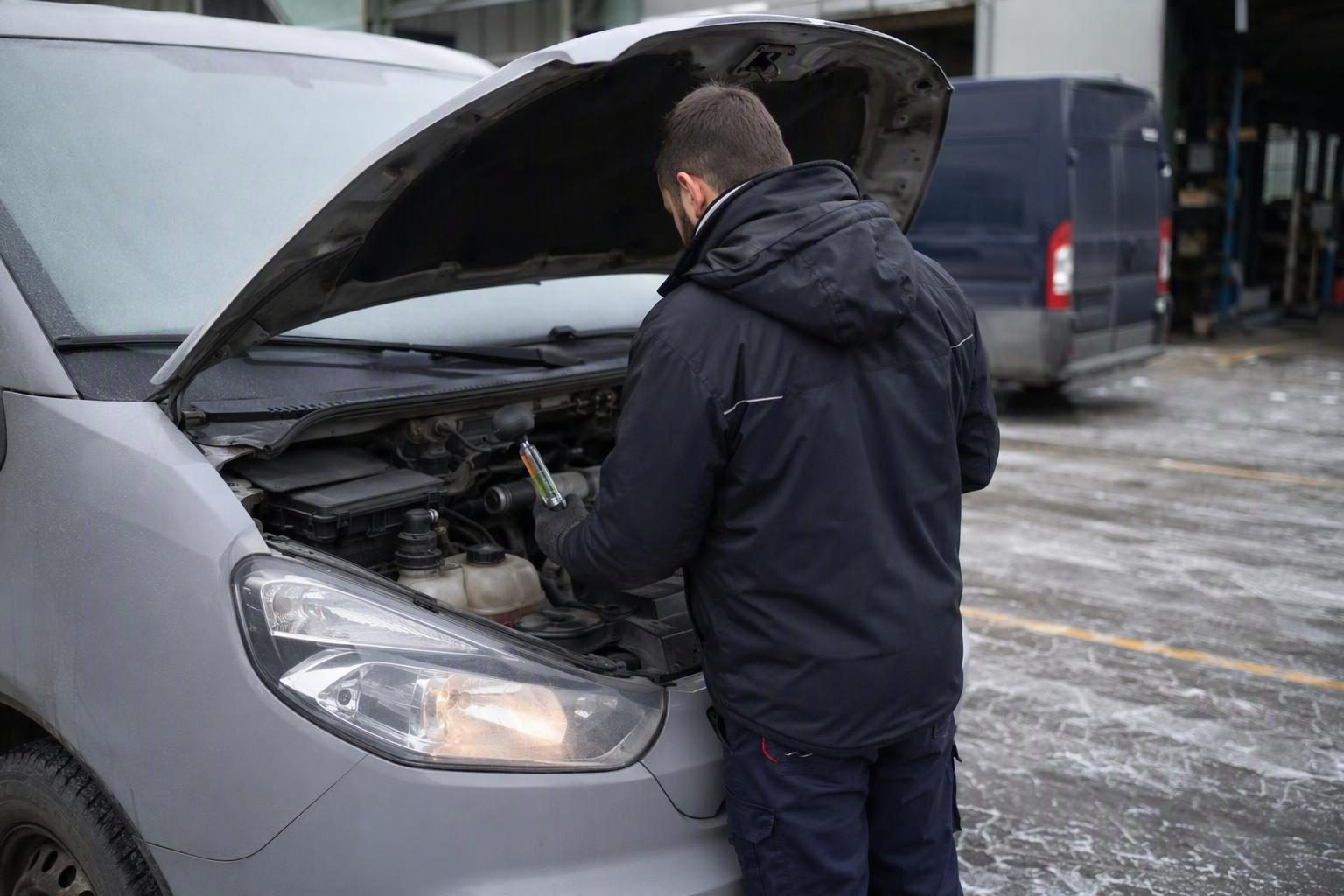
Coolant in vans before winter: planning a check of frost protection
Find out which vans need a pre-frost coolant check, how to interpret the test result and plan visits without unnecessary downtime.
Read article
Lighting checks for a delivery fleet: how to plan inspections and repairs without unnecessary downtime
How to check company van lights, record faults and schedule measurements and repairs without taking several vehicles off the road at once.
Read article
Diesel van will not start after an overnight frost: when to book fuel system diagnostics
Find out what symptoms to report, when to hold a van back from a trip and what the workshop should check in the fuel system.
Read article