
Company Car Breakdown Abroad: How to Arrange Repairs and Document the Costs
When a company car breaks down abroad, the driver should first protect people and secure the place where the vehicle has stopped. They should then contact roadside assistance and the company dispatcher. Repairs and towing should not be approved without first knowing the diagnosis, scope of work, cost, and what roadside assistance will cover. An exception is an urgent intervention required for safety. The procedure below helps reduce the risk of overpaying, unnecessary downtime, and missing documentation.
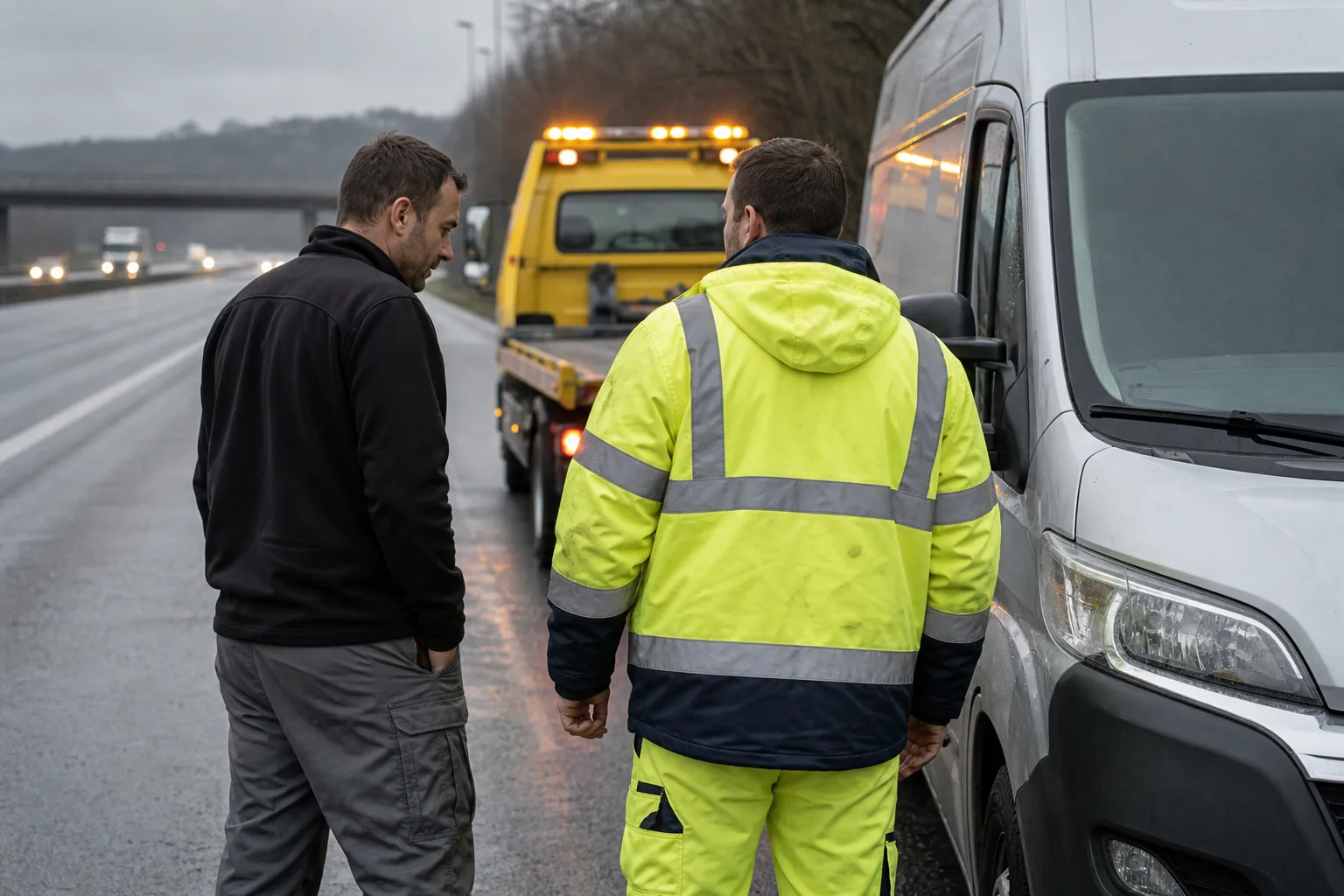
Step 1. Protect people and secure the breakdown site
The driver should move the vehicle to the safest place possible, switch on the hazard lights, and put on a high-visibility vest before getting out. Passengers should move away from traffic. On a motorway or expressway, if conditions allow, they should wait behind the safety barrier rather than in a vehicle stopped next to a traffic lane.
If anyone is injured, there is a fire, or there is an immediate danger, call 112 in the EU or the local emergency number outside the EU. Emergency numbers are for reporting urgent dangers, not for arranging routine towing. Before departure, the company should check the emergency numbers for the destination and transit countries and provide them to drivers. If there is no immediate danger, the driver should contact roadside assistance, the insurer, or the road operator if the route has its own assistance system.
Regulations and required equipment vary between countries. Do not assume that Polish rules on placing a warning triangle apply abroad. The company’s travel instructions should remind drivers to check requirements in the destination and transit countries, including the rules for using a high-visibility vest and warning triangle.
- Do not attempt roadside repairs to the brakes, suspension, or electrical systems. Do not continue driving if the vehicle’s condition or a dashboard warning indicates that doing so may be unsafe.
- Take photos of where the vehicle has stopped and any visible damage only if this can be done without putting yourself or others at risk.
Step 2. Give the company the information it needs to send help
The driver should report the breakdown to the company dispatcher and roadside assistance operator as soon as possible. Saying only that the car has stopped in Germany is not enough. Specific information is needed to identify the location and determine what kind of help is required. It is useful to send a GPS pin, then add the road name, direction of travel, kilometre marker, or nearest exit.
The report should describe the symptoms rather than offer a diagnosis. For example: “A red temperature warning came on, the engine lost power, and the car is stopped in a car park by the exit.” This description helps determine whether a repair shop, mobile service, or towing is needed.
- Country and exact location, registration number, make and model, and mileage.
- Symptoms, dashboard warnings, and whether the vehicle can be moved safely off the road.
- Number of people in the vehicle, type of cargo being transported, and whether it needs to be secured or transferred.
- Policy or roadside assistance programme number, driver’s contact details, and a phone number where they can be reached.
Step 3. Check roadside assistance cover before approving a service
The company dispatcher should check the territorial scope of the roadside assistance cover, the towing limit, and the rules for choosing a repair shop. These details should be recorded together with the case number. Ask separately whether the operator must arrange the towing itself or authorise the repair. Depending on the agreement, a driver arranging a service independently may make it more difficult to settle the cost later.
Also ask whether a replacement vehicle, accommodation, or onward transport for the driver is available if the repair cannot be completed immediately. Do not assume these services are always included or cover any length of time. The terms of the specific policy or manufacturer’s programme apply.
If urgent help is needed for safety reasons, the driver should not wait for formal approval if doing so would create a risk. They should arrange the necessary intervention, notify the company as soon as possible, record who made the decision and on what basis, and keep all confirmations.
- Confirm who will arrange the service: roadside assistance, the road operator, the repair shop, or the company.
- Ask for the case number, service provider’s name, estimated cost, and information on what portion of the expense may be covered.
- For towing, record the vehicle’s collection and drop-off locations, the date, time, and cost.
Step 4. Approve diagnosis separately from repairs
Before the repair shop starts work, the company should receive a diagnosis and an estimate. The document or message from the service provider should describe the identified fault, planned work, parts, labour, towing cost, currency, and local tax. Also ask for the expected completion time and whether dismantling the vehicle could reveal additional work.
If the repair shop cannot estimate the repair cost before diagnosis or dismantling, approve the diagnostic fee separately and set a maximum amount the service provider may spend without further approval. The repair shop should contact an authorised person before exceeding that limit. A telephone approval should also be documented: confirm it by text message or email, specifying the scope and approved amount.
A verbal instruction to “repair it” is not enough. It does not establish whether approval covered diagnosis only or also additional parts and labour. If a language barrier makes the conversation difficult, ask for a written estimate and brief descriptions of the work or parts in a language the dispatcher can verify.
- A common mistake is approving the entire repair without setting a limit or requiring contact if additional costs arise.
- Check that the estimate relates to the specific vehicle and does not include work unrelated to the reported breakdown.
- Record the name of the person approving the work, the date, time, currency, and approved limit.
Step 5. Collect documents for review and cost settlement
Once the repairs are complete, the driver should check that they have received the documents and confirmation that the vehicle has been collected. The company needs more than an invoice: it also needs supporting information to verify what it paid for and who approved the expense. Ask the repair shop to make it possible to link the service to the company and the specific vehicle, for example by including the registration number or VIN on the document.
Formal invoice requirements may vary by country. The list below is a practical checklist, not a guarantee that documents have the same format in every country. The accounting department should assess the documents under the rules applicable to the company.
- Driver’s breakdown report: location, symptoms, photos of dashboard warnings and damage.
- Roadside assistance case number and a record of who arranged the towing or repair and when.
- Service provider’s diagnosis, estimate, cost approval, and any approval for additional work.
- Invoice or receipt itemising work, parts, amounts, currency, and local tax.
- Towing document showing the vehicle’s collection and drop-off locations and the service provider’s details.
- Proof of payment by card or bank transfer, or confirmation that the cost was settled by roadside assistance.
- Confirmation that the vehicle was collected and information about the work performed.
Step 6. Account for the currency and foreign VAT separately
An invoice issued abroad does not automatically mean that the tax shown on it can be deducted in a Polish tax return in the same way as domestic VAT. For expenses incurred in another EU country, a company may, if it meets the conditions, apply for a refund of that country’s VAT under the EU procedure. The application is submitted electronically through the tax administration in the country where the company is established. Eligibility for a refund depends, among other things, on the taxpayer’s status and restrictions in force in the country where the repair was carried out. Having an invoice alone does not guarantee that the tax will be refunded.
An application for a VAT refund for a given period is generally due by 30 September of the following year. The accounting department should check the current procedure and the conditions that apply in the country where the repair was carried out. Do not leave document handling until the final deadline. The EU procedure does not apply outside the EU, so the accounting department should check the rules in the country where the service was performed. The way the expense is recorded, the currency is converted, and the tax is accounted for should be confirmed by an accountant or tax adviser.
- Give the accounting department the invoice, proof of payment, currency, and transaction date.
- Separate the net amount, local VAT, and gross amount if the document shows them separately.
- Keep the diagnosis and cost approval with the invoice so the expense can be linked to the breakdown and the vehicle.
Summary
Add this procedure to your travel instructions and designate a person authorised to approve costs. If you want one point of contact to manage communication with the repair shop, verify the scope of repairs, and organise the documents, use FleetPoint’s repair coordination service.
More from the FleetPoint knowledge base
Coolant in vans before winter: planning a check of frost protection
Find out which vans need a pre-frost coolant check, how to interpret the test result and plan visits without unnecessary downtime.
Read article
Lighting checks for a delivery fleet: how to plan inspections and repairs without unnecessary downtime
How to check company van lights, record faults and schedule measurements and repairs without taking several vehicles off the road at once.
Read article
Diesel van will not start after an overnight frost: when to book fuel system diagnostics
Find out what symptoms to report, when to hold a van back from a trip and what the workshop should check in the fuel system.
Read article