
DPF in a van: when does regeneration make sense, and when is diagnostics needed?
A DPF warning does not automatically mean the filter needs to be replaced. If only the DPF warning light is on, the vehicle retains normal power, and the instructions for that specific model recommend driving to regenerate the filter, follow that procedure exactly. If the van loses power, other warnings appear, the message returns, or there is no improvement after following the instructions, diagnostics are needed before another regeneration attempt. This is the simplest way to avoid longer downtime and paying for a part without confirmation that it is faulty.
What does a DPF warning really mean?
The diesel particulate filter traps soot from the exhaust. During regeneration, soot is burned at a high temperature, but ash remains. Regeneration is therefore not the same as removing ash from the filter, and the warning light alone does not establish whether the filter is clogged, damaged or needs replacing.
Frequent short trips can make regeneration difficult in a van driven mainly in the city. This is useful information for the service center, but by itself it does not prove that there is a fault. How a problem is indicated and what action is recommended depend on the model, engine and system version. There is no single mileage, driving time or speed that guarantees regeneration in every vehicle.
- DPF warning light only, normal power and no other warnings: check the owner’s manual and follow its recommendation.
- Loss of power, additional warning lights, a flashing or recurring message: contact a service center instead of repeatedly attempting regeneration.
- No improvement after following the procedure described by the manufacturer: take the vehicle in for diagnostics.
When can regeneration while driving be considered?
If only the DPF warning light has come on, the vehicle is behaving normally, and the instructions for that vehicle allow driving to regenerate the filter, the driver can follow the specified procedure. Before setting off, they should read the instructions for that specific model, especially those concerning driving conditions and where it is safe to continue the procedure.
The exhaust system reaches a high temperature during regeneration. Do not start the procedure in a place or under conditions prohibited by the owner’s manual. Do not replace the manufacturer’s instructions with online advice that specifies a universal time or speed. If the vehicle is carrying a load, transporting cargo or making another delivery, the driver should not ignore warnings just to complete the job.
- Before driving, check the exact wording of the message and the vehicle’s instructions.
- Check whether any other warning lights are on and whether the engine retains normal power.
- Follow only the procedure specified by the manufacturer and stop if symptoms appear that require the vehicle to be stopped.
- If you are unsure whether it is safe to continue driving, contact a service center and describe the symptoms.
When should you avoid another regeneration attempt?
Loss of power, several warnings appearing at once, a flashing DPF message or no improvement after the recommended action are reasons to arrange diagnostics. The next steps, including whether it is safe to drive to a service center or whether the vehicle should be stopped, must be determined according to the instructions for the specific model and the severity of the symptoms. If the manufacturer instructs you to stop the vehicle, do so as soon as it is possible and safe.
A common mistake by drivers or dispatchers is to repeat regeneration without checking why the previous attempt failed. A forced service regeneration should be preceded by a fault-code readout and an assessment of whether the condition of the filter and the other required conditions allow it. If the problem returns, the service center should first identify the cause rather than simply start the procedure again.
Do not clear fault codes before the workshop has recorded them. They may indicate whether the problem concerns the filter, a measurement, exhaust temperature or another component. Also, do not agree to DPF replacement based solely on a warning light or a single general value found online.
What should you ask the workshop to check before deciding on a repair?
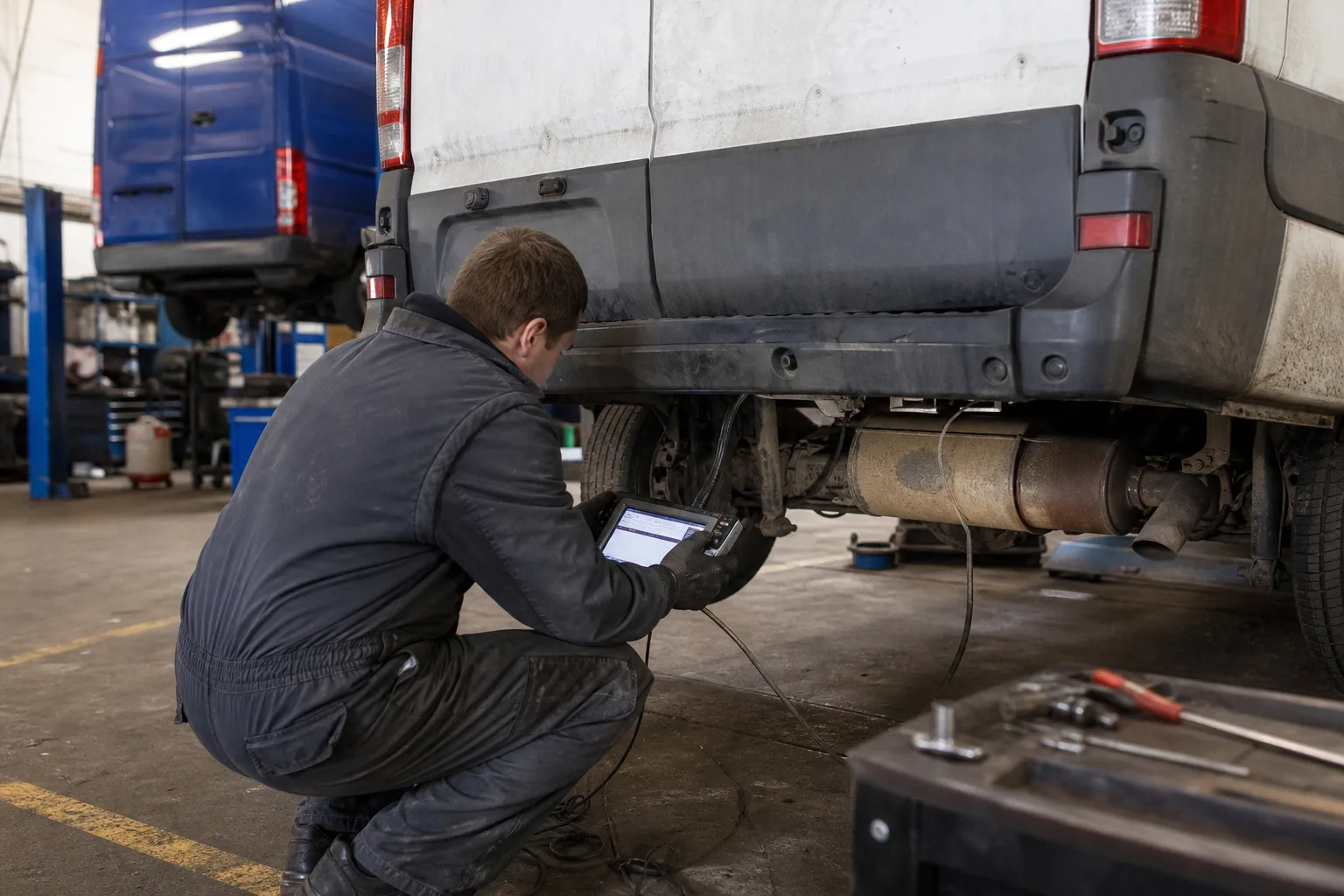
Ask for the sequence of checks and the results on which the decision will be based. The differential pressure sensor and its hoses help the control unit assess flow through the filter. A faulty sensor or a leaking, blocked or damaged connection can distort the assessment of DPF loading. It is also worth checking fault codes and exhaust gas temperature sensor readings, because their signals are needed to control regeneration correctly.
Parameters should be interpreted using the data and procedure applicable to the specific engine. Generic thresholds found online are no substitute for the manufacturer’s specifications. After regeneration, the workshop should check whether the relevant parameters have changed and whether the warning returns. If the filter is loaded with ash, burning off soot alone will not solve the problem. Only an inspection and measurements can determine whether to consider cleaning the filter off the vehicle or replacing it. The DPF should not be removed or disabled through software. The repair should restore the emissions system to working order as intended for the vehicle.
- Ask the workshop to record fault codes and diagnostic data before clearing them.
- Confirm whether the differential pressure sensor, its hoses and the exhaust gas temperature readings have been checked.
- Ask what results were used to decide on regeneration, cleaning or replacement.
- If the problem keeps recurring, require the cause to be identified rather than authorizing another regeneration attempt.
How to report the problem to speed up diagnosis
When reporting the problem, provide information that will help the service center recreate the conditions under which it occurred. A photo of the message is usually more useful than simply saying, “the DPF light is on.” Also describe the vehicle’s typical routes: frequent short trips, stop-and-go traffic, longer journeys or heavy loads. Do not conclude on your own that the filter is clogged. Report the symptoms and leave diagnosis to the measurements.
- Make, model, year, engine version, VIN and current mileage.
- A photo or exact wording of the warning, and information about any other warning lights.
- Whether the vehicle has lost power, entered reduced-power mode or changed its behavior.
- When the problem occurred, whether the message returned and whether the instructions in the owner’s manual were followed.
- Typical routes, recent repairs and any available fault codes.
Reduce recurring problems across the fleet
If several vans make similar short trips, record reports separately for each vehicle. Include the date and mileage, symptoms, type of routes, actions taken, fault codes, repair outcome and time the vehicle was out of service. Over time, it will be easier to see whether the problem concerns one vehicle, a particular usage pattern or recurring repairs.
You can track internally the number of DPF reports per 1,000 km and the share of cases in which the warning returned after a repair. These are management indicators, not manufacturer standards. However, they can help you assess whether the service center resolved the cause and compare repair costs with the cost of vehicle downtime.
Summary
If DPF reports recur across several vehicles, compare their routes, mileage and repair outcomes before changing how the entire fleet is operated. First establish whether the problem results from vehicle operating conditions or a fault with a specific vehicle.
More from the FleetPoint knowledge base
Coolant in vans before winter: planning a check of frost protection
Find out which vans need a pre-frost coolant check, how to interpret the test result and plan visits without unnecessary downtime.
Read article
Lighting checks for a delivery fleet: how to plan inspections and repairs without unnecessary downtime
How to check company van lights, record faults and schedule measurements and repairs without taking several vehicles off the road at once.
Read article
Diesel van will not start after an overnight frost: when to book fuel system diagnostics
Find out what symptoms to report, when to hold a van back from a trip and what the workshop should check in the fuel system.
Read article