
Returning a company car after leasing: what to check before its condition is assessed
Start preparing 30-60 days before the agreement ends: check the return requirements, mileage and equipment, then document the vehicle’s condition in good lighting. Before arranging repairs, agree the process with the finance provider and compare the cost with the settlement terms.
Start with the agreement, not the paintwork
The return is governed by the terms of your specific agreement and the finance provider’s process. Do not assume that criteria in another leasing company’s guidance will also apply to you. Acceptable signs of use, how damage is settled, the documents required and charges for exceeding the mileage limit can all vary.
Gather the agreement, any amendments and the current return instructions. Note the end date, mileage limit, excess mileage rate, equipment requirements and how to report damage. PZWLP (the Polish Association of Vehicle Rental and Leasing) guides for cars and vans can help you identify areas typically assessed, but they are neither a universal price list nor a substitute for your agreement.
- Check who is responsible for notifying the finance provider of the return date and arranging the handover. Some procedures require advance notice.
- Find out whether the vehicle can be repaired before return, which repairer to use and whose approval is required.
- Make a note of the required documents, keys and equipment.
- Confirm whether any bodywork or additional equipment must remain in the vehicle. Do not remove it without checking the terms.
A schedule that leaves time to make decisions
If several vehicles are due for return around the same time, do not leave inspections until the last few days. The schedule below is an internal planning buffer, not a statutory deadline. Adapt it to the finance provider’s process and the number of vehicles to prepare.
The key is to allow enough time before the agreement ends to obtain an estimate, get repair approval and complete the work. If anything is unclear, ask the finance provider to confirm its position in writing rather than relying on a telephone conversation.
- 60 days before the end: gather the return terms, mileage limit, and lists of equipment and documents. Identify vehicles that will need particular attention.
- Around 30 days before the end: inspect the vehicles, take photographs and record the mileage. Arrange the handover and an initial assessment of any damage found.
- By 14 days before the end: obtain estimates and written guidance from the finance provider on repairs or reporting damage.
- In the final week: confirm the handover date, documents, keys and equipment. Plan the handover so it does not disrupt the company’s work.
Inspection: document what can be compared later
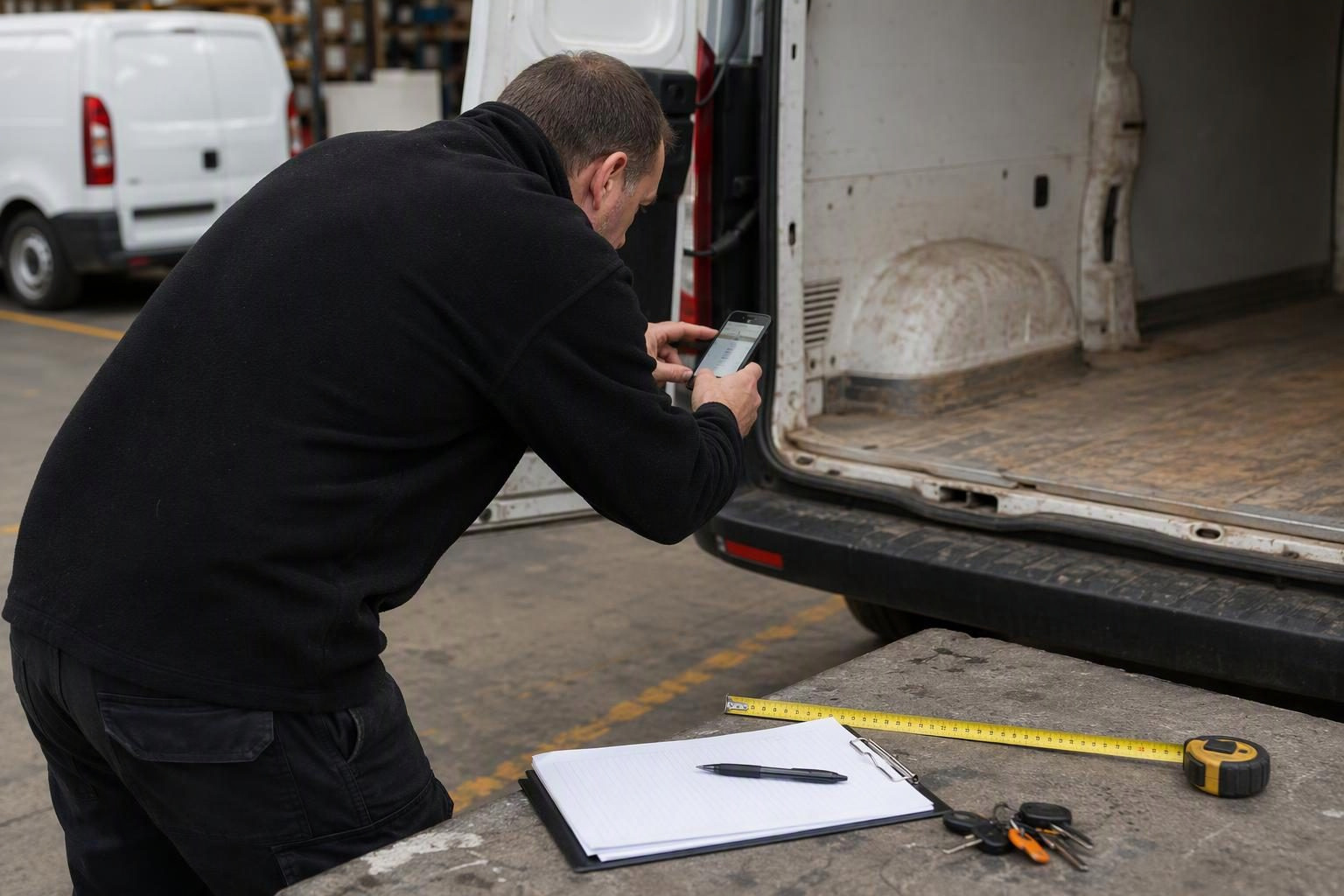
Inspect the vehicle when it is clean and dry, in good lighting. Record the date and mileage, then photograph the vehicle from every side. Take separate photographs of the windows, wheels, tyres, cabin, dashboard and load compartment. For any damage, show both its position on the vehicle and a close-up with a scale, such as a tape measure.
For a van, do not stop at the bodywork. Check the floor and walls of the load compartment, sills, sliding and rear doors, locks, bodywork, lighting, wheels and visible underbody components. Look for damage related to carrying and securing loads. Do not try to assess for yourself whether structural or underbody damage is safe.
Photographs and notes help organise your records, but do not by themselves guarantee that a complaint will be accepted. Keep the original files, correspondence, estimates and repair confirmations. For a larger fleet, link the material to the relevant vehicle, for example by registration number and date.
- Take overall photographs as well as close-ups, rather than photographing just one scratch.
- Record the mileage and inspection date. Compare the mileage with the agreement’s limit and rate.
- Check the tyres for visible damage and uneven wear, but do not decide on your own whether they meet the return requirements.
- Document the condition of the upholstery, floor, walls and bodywork in the cabin and load compartment.
Which faults should be checked by a repairer
Not every visible fault is purely cosmetic. Before returning the vehicle, arrange an assessment of warning lights, leaks, unusual noises or vibrations, braking, steering or suspension problems, faulty lights, damaged windows, concerning tyre condition, and locks or door mechanisms that do not work.
This is a list for an initial assessment, not a diagnosis. A professional repairer should check faults that affect safety or the vehicle’s proper operation. If the vehicle behaves abnormally while driving, do not put off an assessment just because the lease is ending. If in doubt, contact a repairer and establish whether the vehicle can be used safely until the appointment.
- Record the symptom, when it occurs and any message displayed on the dashboard.
- Give the repairer the registration number and mileage, as well as photographs or a recording of the symptom if it can be captured safely.
- Ask for technical faults and cosmetic repairs to be listed separately in the estimate.
- Do not assume in advance that a noise, warning light or leak will be classed as normal wear and tear.
Repair before return or leave the vehicle for assessment?
It is not always worthwhile to arrange repairs before handing over the vehicle. First check how the finance provider settles the specific damage and whether it requires a particular repairer or process. For bodywork or mechanical damage, also contact the insurer if a claim under the policy may apply.
Ask the repairer for an estimate and the finance provider to confirm in writing what you should do. Compare the repair cost with the expected settlement under the agreement. Do not apply depreciation tables or figures from one finance provider’s guide to a different agreement. Do not repair damage or remove additional equipment until you know what process is required.
- Note the claim reference number and keep the estimate and the decision from the finance provider or insurer.
- Confirm in writing where and how the vehicle can be repaired, and which documents will be required.
- After the repair, keep the invoice or work order and photographs taken before and after the work.
- For each item, make and record a decision: repair it, submit it for settlement or leave it for assessment.
Complete equipment and the handover report
A missing key or item of equipment can complicate the handover and settlement, so check everything against the list for your vehicle. The finance provider may require, among other things, all keys, factory-fitted equipment, the registration document, an insurance policy or a service book if one was issued. Confirm the specific requirements in your return instructions.
At handover, make sure the report describes the vehicle’s condition and any damage found. Read it before signing. If you disagree with the description, ask for a note to be added and attach your own records. Keep a copy of the report and confirmation of the date and time of return.
- Check the keys, documents, accessories and equipment against the finance provider’s list.
- Check that the report includes the mileage and a description of the vehicle’s condition.
- Do not sign without reservations if the description omits visible differences or does not match your photographs.
- Archive the report, photographs and correspondence with the records for the relevant vehicle.
How to organise the return of several vehicles
For a larger fleet, prepare a single return schedule showing each agreement’s end date, mileage, document status, damage found and decision status. Assign a person to be responsible for each vehicle. This helps avoid missed deadlines and prevents faults or equipment from being overlooked during driver changes.
You could set the following internal process targets: inspect each vehicle at least 30 days before return, document all damage found, have no missing items on the handover date and have no unresolved faults affecting safety. These are organisational targets, not a guarantee of a particular settlement outcome. For a larger number of vehicles, the schedule will also help identify in advance where a repair booking or a decision from the finance provider is needed.
Summary
FleetPoint can coordinate return dates, oversee contact with repairers, and organise records and settlements for individual vehicles. Having one person manage the process helps track the preparation status of every vehicle.
Sources
- Przewodniki zwrotu pojazdów PZWLP - Polski Związek Wynajmu i Leasingu Pojazdów
- Przewodnik Zwrotu Pojazdów - samochody dostawcze - Polski Związek Wynajmu i Leasingu Pojazdów
- Przewodnik użytkowania i zwrotu pojazdu - samochody dostawcze - Volkswagen Financial Services
- Dla klienta najmowego - zakończenie umowy - Volkswagen Financial Services
- Jak przebiega zwrot pojazdu w Volkswagen Financial Services? - Volkswagen Financial Services
More from the FleetPoint knowledge base
Coolant in vans before winter: planning a check of frost protection
Find out which vans need a pre-frost coolant check, how to interpret the test result and plan visits without unnecessary downtime.
Read article
Lighting checks for a delivery fleet: how to plan inspections and repairs without unnecessary downtime
How to check company van lights, record faults and schedule measurements and repairs without taking several vehicles off the road at once.
Read article
Diesel van will not start after an overnight frost: when to book fuel system diagnostics
Find out what symptoms to report, when to hold a van back from a trip and what the workshop should check in the fuel system.
Read article